



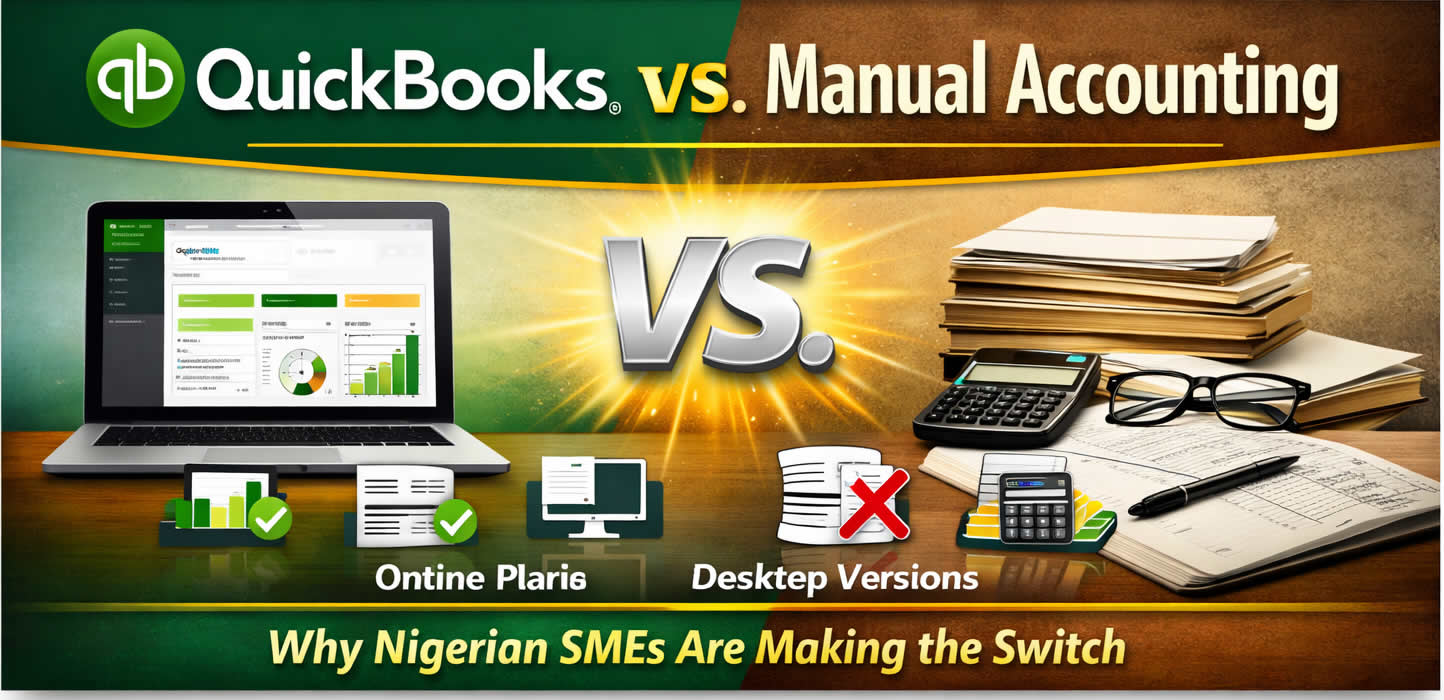
For decades, Nigerian business owners have relied on handwritten ledgers, spreadsheets, and gut feeling to manage their finances. But in today’s competitive market — where FIRS demands accurate VAT returns, banks require clean financial statements for loans, and investors want auditable records — manual accounting is no longer enough. QuickBooks is changing the game for SMEs across Lagos, Abuja, Port Harcourt and beyond.
- The real cost of manual accounting in Nigeria
- What QuickBooks actually does differently
- Side-by-side comparison
- Common mistakes manual bookkeeping causes
- How QuickBooks fixes them
- Real results from Nigerian businesses
- Is QuickBooks right for your business?
- How TekTins can help you make the switch
The real cost of manual accounting in Nigeria
When most Nigerian entrepreneurs think about switching from manual accounting, they focus on the software cost. But the more important question is: what is manual accounting already costing you?
Consider a typical Lagos trader running a mid-sized import business. Their accountant spends three days every month manually reconciling cash receipts, chasing missing invoices, and typing figures into Excel. Then, when FIRS calls for a VAT audit, the business scrambles to reconstruct months of records from scraps of paper. The resulting fines, the hours lost, the stress — none of that shows up in the accounting software budget.
What QuickBooks actually does differently
QuickBooks is not just a digital ledger. It is a complete accounting system that automates the repetitive, error-prone tasks that take up most of a small business owner’s financial management time. Here is what that looks like in practice for a Nigerian business:
Data entered by hand, prone to formula errors, version confusion, and data loss. Reconciliation done at month end — often in a rush.
Transactions recorded instantly, bank feeds auto-imported, VAT calculated automatically, and reports generated in seconds — any time of day.
“The moment a Nigerian SME owner can see their profit and loss in real time — not at month end — they start making better decisions. That is the QuickBooks difference.”
Common mistakes manual bookkeeping causes
Manual accounting does not just slow you down — it creates specific, recurring errors that can have serious consequences for Nigerian businesses. Here are the most damaging ones:
Nigeria’s VAT rate is 7.5%. Manual calculation on hundreds of transactions leads to over-remittance or under-remittance — both of which attract FIRS penalties.
Without a structured system, Nigerian sole traders routinely dip into business cash for personal expenses and forget to record it. This distorts profit figures and creates tax headaches.
Manual ledgers make it hard to track who owes you and for how long. Businesses unknowingly carry months of unpaid receivables — strangling their cash flow.
When Nigerian SMEs apply for a loan or facility, banks demand audited accounts and financial statements. Manual ledgers rarely meet this standard — and deals fall through as a result.
How QuickBooks fixes them
QuickBooks calculates and tracks VAT on every invoice and expense automatically, generating a ready-to-submit VAT return for FIRS at the end of each period.
With QuickBooks, you set up dedicated business accounts from day one. The system flags any transaction that looks out of place, keeping your books clean and accurate.
Accounts receivable ageing report
QuickBooks shows you every unpaid invoice, who owes it, and how many days overdue it is — so you can chase payments before they become bad debts.
Bank-ready financial statements
QuickBooks generates Profit and Loss statements, Balance Sheets, and Cash Flow reports at the click of a button — formatted exactly the way Nigerian banks and auditors expect them.
Real results from Nigerian businesses using QuickBooks
Across Nigeria, businesses that have moved from manual systems to QuickBooks consistently report the same outcomes: more time to focus on running their business, fewer errors at tax time, and a clearer picture of their finances.
A logistics company in Ikeja cut their monthly bookkeeping time from four days to six hours after switching to QuickBooks Online and connecting their GTBank account via bank feed. A fashion retailer in Abuja identified over ₦800,000 in uncollected invoices within the first week of using the Accounts Receivable feature — money that had simply been forgotten in their manual system.
“Once your books are on QuickBooks, you stop guessing whether your business is profitable. You know — right now, today.”
Is QuickBooks right for your business?
QuickBooks works exceptionally well for Nigerian businesses in retail, trading, logistics, consulting, professional services, hospitality, and manufacturing. If your business issues more than ten invoices a month, has at least two or three expense categories, and needs to file VAT with FIRS, QuickBooks will save you time and money from day one.
For very small sole traders handling fewer than five transactions per week, a basic spreadsheet may still suffice — but the moment you plan to grow, hire staff, or access bank financing, QuickBooks becomes essential rather than optional.
How TekTins Nigeria Ltd can help you make the switch
At TekTins Nigeria Ltd, we do not just sell you a QuickBooks licence and disappear. We assess your current accounting setup, migrate your existing data into QuickBooks, configure it properly for Nigerian tax requirements, and train your team to use it confidently from day one.
Our clients across Lagos, Abuja, Port Harcourt, and other Nigerian cities have made the switch seamlessly — and they never look back at their paper ledgers.
Ready to leave manual accounting behind?
Contact TekTins Nigeria Ltd for a free QuickBooks consultation. We handle everything — setup, migration, and training.
Comments are closed