



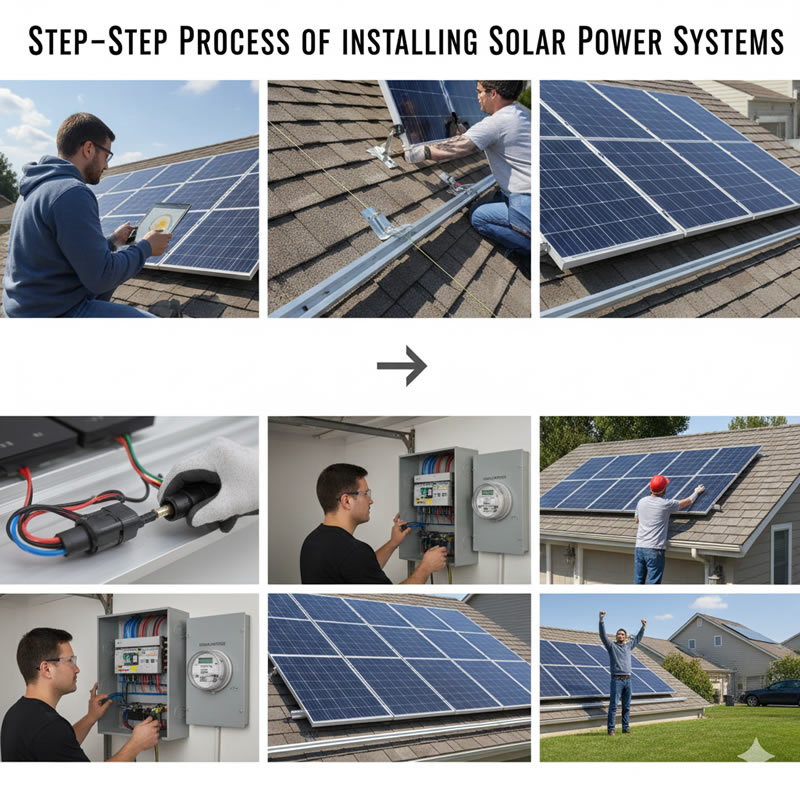
While many homeowners hire professionals, understanding how to install solar power system components helps you oversee the project or even tackle a DIY installation safely.
Phase 1: Planning and Permitting
Before any hardware touches your roof, you must handle the logistics.
-
Energy Audit: Review your past 12 months of electricity bills to determine the system size you need.
-
Site Assessment: Ensure your roof is structurally sound and receives adequate sunlight (ideally south-facing in the Northern Hemisphere) without shading from trees or chimneys.
-
Permits and Paperwork: You will need building and electrical permits from your local municipality. You must also apply for Interconnection with your utility company to feed excess power back to the grid.
Phase 2: Hardware Installation
Once you have your permits and equipment, the physical installation follows a specific sequence.
1. Mounting the Racking System
The racking is the skeleton that holds your panels.
-
Install flashing and roof mounts into the rafters to ensure a leak-proof seal.
-
Attach the aluminum rails to these mounts.
-
Critical Check: Use a level to ensure the rails are perfectly aligned; even a slight tilt can make the final panel array look crooked.
2. Installing the Solar Panels
With the racking secure, the panels (modules) are lifted onto the roof.
-
Placement: Secure the panels to the rails using mid-clamps and end-clamps.
-
Wiring: Connect the panels in “strings” using MC4 connectors. Most modern systems use Microinverters (one under each panel) or a String Inverter (one central unit).
3. Electrical Wiring and Component Connection
This is the most technical part of how to install solar power system hardware.
-
The Inverter: Install the inverter near your main electrical panel. This device converts Direct Current (DC) from the panels into Alternating Current (AC) for your home.
-
Disconnect Switches: Install AC and DC disconnects so the system can be manually turned off for maintenance or in emergencies.
-
The Battery (Optional): If you are going off-grid or want backup power, connect your solar charge controller to a battery bank.
Phase 3: Inspection and Commissioning
You cannot flip the switch as soon as the last wire is connected.
-
City Inspection: A local inspector will visit to ensure the wiring meets the National Electrical Code (NEC).
-
Utility PTO: After the city signs off, your utility company will grant Permission to Operate (PTO). They may install a “net meter” to track the energy you send back to the grid.
-
System Startup: Turn on the breakers, and your system will begin generating power.
Warning: Solar panels generate electricity the moment they are exposed to light. Always treat wires as “live” and wear insulated gloves and fall-protection gear when working on a roof.
Comments are closed