



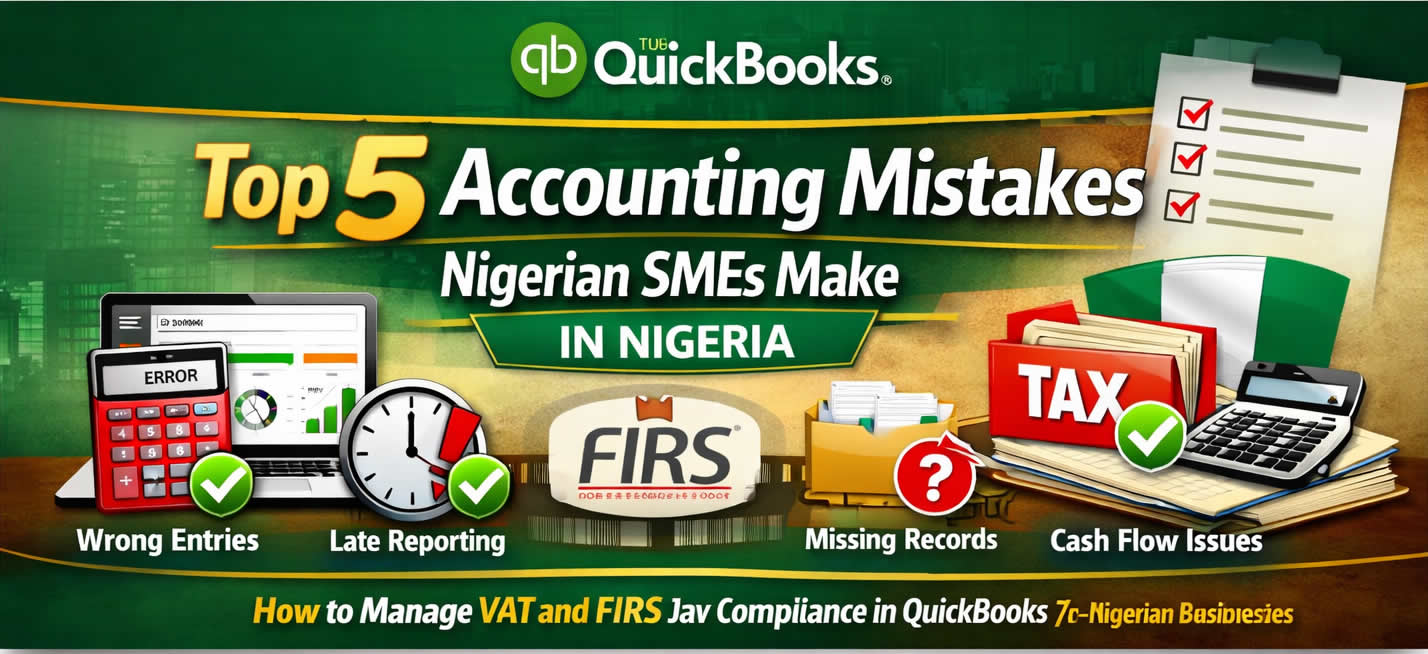
- Mixing personal and business money
- Not tracking every expense
- Ignoring accounts receivable until it’s too late
- Guessing instead of reconciling
- Leaving tax preparation to the last minute
Nigeria has over 39 million small and medium-sized enterprises, according to SMEDAN. They employ more than 80% of the workforce and account for nearly half of the country’s GDP. Yet a staggering proportion of these businesses struggle financially — not because they lack customers or products, but because their internal financial management is broken from the start.
The pattern is always the same: a business starts small, the owner manages money by instinct, things seem fine for a while — then growth exposes the cracks. An audit is triggered. A big customer demands financial records. A bank denies a loan. At that point, fixing the books is ten times harder than getting them right from day one.
01 Mistake: Mixing personal and business money
The number one financial sin of Nigerian small business owners
It starts innocently. The business account is short, so you move some money from your personal savings to cover a supplier payment. Or you use the business card to pay for your children’s school fees and plan to refund it later. Before long, nobody — not even you — knows how much the business actually earns or owns.
This is the single most destructive accounting habit among Nigerian SMEs. When personal and business finances are mixed, it is impossible to measure true profit, prepare accurate financial statements, or separate business liabilities from personal assets. If FIRS audits you, a blurred boundary between personal and business funds is a serious red flag. And if you ever apply for a business loan, any bank worth its name will reject your application the moment they see commingled funds.
A catering business owner in Surulere discovered she had unknowingly subsidised her business operations with over ₦2.4 million of personal funds over two years — money she assumed was business profit. Her business appeared healthy on paper while she personally ran dry.
How QuickBooks fixes it
QuickBooks requires you to set up dedicated business accounts from the start. Every transaction is categorised as either a business income, business expense, or an owner’s drawing — making it immediately clear when personal money enters or exits the business. The Owner’s Equity account tracks capital contributions and withdrawals separately, keeping your books clean and your financial picture honest.
02 Mistake: Not tracking every expense — no matter how small
Small leaks sink big ships in Nigerian business
Petty cash expenses are the silent profit killers of Nigerian small businesses. The ₦2,000 spent on generator fuel. The ₦5,500 on Bolt rides to a client meeting. The ₦1,800 on airtime for business calls. Individually they seem trivial. But for a business operating six days a week, these unrecorded micro-expenses can easily amount to ₦300,000 or more per year — all of it gone with no record, no deduction, and no trail.
Beyond petty cash, many Nigerian business owners fail to keep receipts for major business expenses — rent, equipment, raw materials — because they assume they will remember. They rarely do. And when tax time comes, every undocumented expense is a missed deduction that inflates their taxable income unnecessarily.
A small printing business in Ikeja was paying Company Income Tax on ₦8.2 million in declared profit. After a proper QuickBooks setup recovered and categorised two years of undocumented expenses, their actual taxable profit dropped to ₦5.1 million — a difference of over ₦900,000 in unnecessary tax paid.
How QuickBooks fixes it
QuickBooks Mobile allows you or your staff to photograph receipts on the spot and attach them to transactions in real time. The QuickBooks bank feed automatically imports transactions from your GTBank, Access, or Zenith account daily, ensuring that no expense slips through the cracks even if you forget to record it manually. Every naira in and out is captured, categorised, and ready for tax reporting.
03 Mistake: Ignoring accounts receivable until it is too late
The ₦-owed-to-you problem that kills cash flow
Nigerian business culture is heavily relationship-driven, which is wonderful for building trust — but it can be devastating for collecting payments. Many Nigerian SMEs issue invoices and then feel too uncomfortable to follow up aggressively when clients do not pay on time. The invoices pile up in a drawer, the client relationship is carefully managed, and meanwhile the business is slowly starving for cash while it technically shows impressive sales figures on paper.
This gap between what you are owed and what is actually in your account is one of the most common reasons Nigerian businesses with healthy revenue still struggle to pay salaries on time, restock inventory, or meet their own supplier commitments.
“A business can be profitable on paper and broke in practice. Uncollected invoices are the phantom profits of Nigerian SMEs.”
How QuickBooks fixes it
QuickBooks’ Accounts Receivable Ageing Report shows every outstanding invoice grouped by how long it has been unpaid — under 30 days, 31–60 days, 61–90 days, and over 90 days. You can see at a glance exactly who owes you, how much, and for how long. QuickBooks also allows you to set up automatic payment reminders that are sent to clients by email on a schedule you define — professionally worded, and without the awkwardness of a personal phone call.
04 Mistake: Guessing instead of reconciling bank accounts
When your books and your bank account tell different stories
Bank reconciliation is the process of matching the transactions in your accounting records to the transactions on your bank statement to ensure they agree. For many Nigerian small business owners, this process simply never happens. They check their bank balance via their mobile app and assume that figure represents the financial health of their business. It does not.
Your bank balance does not account for outstanding cheques that have not yet cleared, unrecorded cash transactions, bank charges that have not been entered, or deposits in transit. Without regular reconciliation, your books slowly drift away from reality — and by the time the error is discovered, untangling months of discrepancies can take days of painful reconstruction.
An events company in Abuja discovered a ₦1.8 million discrepancy between their records and their bank statement after 14 months of unreconciled accounts. The culprit: a supplier had double-charged them seven times, and a staff member had made unauthorised transfers totalling ₦340,000. Neither was caught in time because no reconciliation process was in place.
How QuickBooks fixes it
QuickBooks makes bank reconciliation a structured, guided monthly process. It imports your bank statement, lines it up against your recorded transactions, and highlights any mismatches for your review. What used to take a full day of manual work now takes under an hour. QuickBooks also flags duplicate transactions and unusual entries automatically — acting as an early warning system for errors and potential fraud before they become major problems.
05 Mistake: Leaving tax preparation to the last minute
The annual panic that costs Nigerian businesses dearly
Ask any Nigerian accountant what the most stressful period of their year is, and the answer will be unanimous: the weeks before a tax deadline. Clients arrive in a frenzy with shoeboxes full of receipts, incomplete records, missing invoices, and no idea what their actual profit was for the year. The accountant then has to reconstruct twelve months of financial activity in a matter of days — charging premium rates for the urgency, making judgement calls that may not hold up under a FIRS audit, and producing numbers that are at best approximate.
The result is a tax return that may over- or under-state profit, a business owner who has no real understanding of their financial position, and an accountant who has done their best with inadequate information. Everyone loses — except FIRS, which collects penalties if anything is wrong.
Last-minute tax preparation typically costs 3–5 times more in accountant fees than year-round bookkeeping. And if FIRS selects you for a random audit, reconstructed records rarely pass scrutiny — leading to additional assessments, penalties, and the kind of FIRS attention no Nigerian business wants.
How QuickBooks fixes it
When QuickBooks is used consistently throughout the year, tax preparation is not an event — it is a formality. Every income and expense is already recorded, categorised, and tagged. Your Profit and Loss statement, Balance Sheet, and VAT Summary are available instantly for any date range. Your accountant spends time reviewing and optimising rather than reconstructing, which means lower fees, more accurate filings, and zero last-minute panic.
Your action plan — fix all five mistakes starting today
You do not need to fix everything at once. Start with the mistake that resonates most strongly with where your business is right now, and build from there. Here is a simple sequence that works for most Nigerian SMEs:
-
Open a dedicated business bank account if you have not already — separate from any personal account, immediately.
-
Set up QuickBooks with professional help — correct configuration from day one saves months of correction later.
-
Connect your Nigerian bank account via QuickBooks bank feed so every transaction is captured automatically.
-
Run your Accounts Receivable Ageing report on the 1st of every month and chase anything over 30 days immediately.
-
Schedule a monthly 30-minute bank reconciliation session in QuickBooks — treat it like a standing team meeting.
-
Send your accountant a QuickBooks report at the end of each quarter — not a shoebox in March.
Stop making expensive accounting mistakes
TekTins Nigeria Ltd will set up and configure QuickBooks for your business — and train your team to use it properly from day one.
Comments are closed